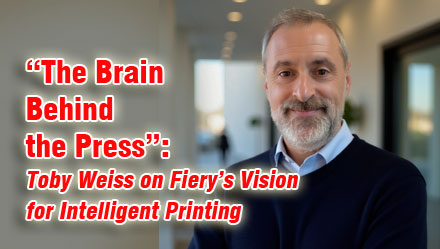
In this exclusive interaction with Veerendra Malik, Editor-in-Chief of Digital Impressions, Toby Weiss, Chief Executive Officer at Fiery LLC, shares insights on how Fiery continues to power the global digital printing ecosystem as the intelligent core behind the world’s leading digital presses. From driving performance, color accuracy, and automation to enabling seamless workflows across diverse print environments, Fiery has redefined what digital front ends (DFEs) can achieve. Toby discusses Fiery’s innovation roadmap, its expanding role across commercial and industrial printing, and how the company is preparing print providers for a more connected, data-driven, and sustainable future.
Veerendra Malik (VM): Fiery is often called “the heart of the
press.” How exactly does it make a digital press run faster,
more reliably, and more profitably? What are the top areas
where Fiery makes the biggest difference?
Toby Weiss (TW): No offense to the heart, but we like to
think of ourselves as the brain behind a print room, with the
printer as the muscle. Either way we are flattered. A digital
front end or DFE is the central nervous system of a digital
press that unlocks its full potential. As the print industry’s
leading innovator of DFEs for over three decades, Fiery is
laser-focused on creating technologies explicitly designed to
deliver what benefits print operations the most: print speed,
color quality, job management, and integration. Our RIP
technology is the best in the industry, with lightning-fast
processing speeds that keep presses running at their
maximum capability with minimum downtime – a
combination of advanced algorithms and in-house specialty
processing chips delivers this processing power. Fiery is
also a leader in color solutions (like Fiery ColorGuard), which
make color management and color control easy and
automated for both experienced
color experts and new operators.
Our job management software
solutions like Fiery JobFlow
streamline everything in the
workflow chain from prepress to
business analytics. And our
integration capabilities mean that
all devices on the print floor – from
printers to cutters and finishers and
more – are all connected through
the same Fiery interface. In short:
Fiery is the print genius that’s got your back to make printing
as efficient, user-centric, reliable, scalable, and secure as
possible.
VM: Colour accuracy is critical. How does Fiery ensure
consistent, accurate colours—even for brand colours—
across different machines and runs?
TW: We actually just wrote a blog about this topic! Fiery is
known for the best and most accurate color because of our
advanced algorithms, technology and tools. This includes
two main components: color management and color control.
For color management, tools like Fiery Color Profiler
Suite make use of a press’s inline spectrophotometer to
print, measure, and create an ICC profile for the color
settings of your job on that specific printer and media. But
then, due to shifts in environmental conditions, toner
batches, and printer wear, those color settings might start to
drift from what you initially had. That’s where color control
comes in. Fiery ColorGuard is a solution that automatically
verifies, corrects, and maintains color output across your
devices without stopping production or requiring operator
input. ColorGuard removes the need for manual checks, warmup jobs, and unnecessary recalibrations – it’s like a
fitness tracker for your printer’s color health, making color
control significantly more streamlined.
VM: Many printers run multiple brands of presses. How
does Fiery help unify production so results look the same
across different presses?
TW: Our approach to this problem is very different than
others. Our main goal is to ensure that customers have the
best production experience regardless of the digital press
they choose as long as that press runs a Fiery DFE. This is
quite different than an OEM who may try to lock a customer
into their software, regardless of how useful or applicable it is
to the customer. We believe customers should be able run
the best workflow on whatever press is best for their
business, so our workflow is consistent across nearly all
major OEM brands thanks to our Fiery Command
WorkStation and Fiery IQ cloud solutions that are the same
regardless of which press brand a customer chooses. Fiery
is actually the company that works with the largest number of
OEM partners in the entire print industry. We have teams that
work with each major OEM partner
to create Fiery products specifically
designed to optimize the
performance and results from each
press. Because of this, we get both
a specific, detailed view of the
strengths of each individual press,
but also a broad, horizontal
understanding of what
technologies, processes, and
designs deliver the best results in
patterns across digital printing.
“We like to think of Fiery not
just as the heart, but the brain
behind the print room —
unlocking the full potential of
every digital press”
VM: As files are getting more complex, how is Fiery
preparing to handle future file formats and increasingly heavy
graphic designs?
TW: We are leading the charge here and working with our
partners, dealers, and customers to make sure they
understand what’s coming. Very often a customer will
evaluate a DFE or workflow solution based upon the current
files they get from their current customers. It’s critical that
customers look forward so that they chose a DFE that
supports more complicated work than what they have today,
so their solution isn’t outdated a year or two after they install
it. Our Fiery DFEs include our special VX600 chip that allows
for ultrafast processing of complicated files. It’s not
uncommon to hear a customer report that Fiery takes
seconds to process a complicated graphic or variable print
file that other solutions take minutes to process. Our R&D
team continues to develop new hardware and software
technology that advance processing speeds and efficiency,
and Fiery strives to make sure that its technology is ahead of
future market demand related to complexity and new design
capabilities.
VM: Artificial Intelligence is
everywhere—where do you see AI
being most useful in Fiery, whether
in colour correction, job
scheduling, or reducing operator
intervention?
TW: AI is not just useful, it’s a
vital component of our vision for
digital printing. We actually talked
about the Fiery AI vision of the print
room earlier this year – as much as
AI is a fundamental leap forward in terms of capabilities, we
see it as just the next step in Fiery’s decades-long
commitment to delivering better automation in printing. We
don’t incorporate AI just for its own sake, nor do we throw it
around as a buzzword; rather, we focus on solving concrete,
tangible, real-world problems print businesses face by
utilizing the power of AI to deliver smoother, stronger, more
intuitive automation capabilities. This is clear in two AIpowered
products we’re launching later this year: Fiery
Scribe, which uses LLMs to automatically scan a customer’s
incoming job request email and convert it into a job ticket,
potentially eliminating the time it takes to manually input job
request emails from customers; and Fiery InkWise, which
uses AI to analyze a print business’s historical ink usage
over time, and create an optimized schedule of ink
purchasing to ensure you always have exactly the right
amount of ink you’re going to need. These products are
designed to reduce operator intervention and deliver the
most automated solutions possible, where the DFE can do a
deep, intelligent inspection and make the right decision for
the customer – just like how phones these days
automatically pull up the optimal camera settings when you
take a picture. In terms of color correction, we recently
showed off some new technology that looks at the details of
an image, determines the objects in the image, and can then
do automatic spot color selection based upon that. Imagine
for example that you are printing a picture of someone
holding a can of Thums Up. Fiery’s tech will be able to
determine the brand color of the bottle and automatically
make sure it prints as Thums Up Red. We could do the
same with someone wearing a sports jersey from a famous
team. This object-based color technology is similar to how
self-driving cars recognize objects in the road, and is a
game-changer for color accuracy in printing.
.
VM: Beyond commercial printing, Fiery is used in
packaging, textiles, and industrial printing. How is Fiery
adapting to those unique needs?
TW: Yes, both industrial applications like packaging and
labels and specialty print applications like textiles and directto-
film are major areas of focus for Fiery. What we know is
that in each market, customers care about exceptional color,
high-speed processing being integrated with the rest of their ecosystem, and ease of use. In
each of these markets, it’s often the
workflow and the ecosystem that
are slightly different, so we focus
on making unique changes for
each application. On the industrial
side, Fiery Impress is a turnkey
DFE solution we launched that
is designed to
help industrial inkjet press makers
get new presses off the ground
fast. Instead of spending months engineering a DFE,
OEMs can integrate Fiery Impress into their designs and be
production-ready in weeks with a cutting-edge industrial
application-specific DFE. We also recently announced a
deep integration with Esko where we seamlessly integrate
Fiery Impress with Esko’s workflow, and we also have deep
integration with Esko’s color management system because
packaging customers want that. On the specialty print side,
Fiery’s Digital Factory suite of products delivers powerful
results across a range of different applications. More than
just RIP software, Digital Factory offers high-fidelity color
printing along with professional job preparation and
management tools to streamline production workflows from
start to finish.
“AI isn’t just a buzzword for
us — it’s the next step in Fiery’s
long-standing mission to make
printing smarter, faster, and
more intuitive”
VM: How does Fiery work with inline quality control tools,
like scanners or cameras, to automatically check and correct
print quality?
TW: Fiery already provides and continues to enhance
various hardware and software technologies related to
closed-loop inspection systems. For example, Fiery Impress
for single-pass high-speed industrial inkjet print integrates
with inline cameras and scanners to enable detection and
compensation for clogged nozzles, measure inkjet heads
non-uniformity to output correct print quality, etc. Another
example is Fiery ColorGuard, which works seamlessly with a
press’s inline measurement instruments – like the inline
spectrophotomer in the Canon imagePRESS series – to
deliver precise, automatically verify, correct, and maintain
accurate color output over time without the need for operator
intervention. Because we work with nearly every major print
OEM, we have an intimate understanding of the power of
inline measurement technology and techniques to refine print
quality and get the best results every time from any press.
.
VM: Sustainability is top of mind. How does Fiery help
reduce waste, save materials, and improve efficiency for
printers?
TW: Fiery technology is all about efficiency. From
eliminating wasted test jobs thanks to Fiery ColorGuard’s
automatic color control capabilities, to Fiery InkWise directly
reducing the amount of ink on a print business’s shelf that
expires, we aim to deliver efficiencies in material usage
wherever we can in the print production process. And certainly as proponents of the
worldwide shift from offset printing
to digital print, we see strong
benefits to reducing waste there. In
addition, about a year ago, Fiery
was fully acquired by Japanese
print legend Seiko Epson
Corporation. Epson is strongly
committed to sustainability, which
resonates with Fiery’s core values.
VM: Fiery partners with many press manufacturers. Can
you share examples of how these collaborations have led to
stronger print capabilities?
TW: Ultimately, customers don’t want to be locked in to
one OEM’s tech, and they want the freedom to buy the right
press at the right time for their business. They might have
mixture of presses or they might change presses as their
business changes. By supporting the industry’s widest range
of brands and printer models, Fiery helps customers with this
freedom. It’s fundamental to our technology model: we
create the world’s best DFEs that run the world’s best
printers. Some recent examples including powering the new
Epson SureColor G6070 with custom Fiery Digital Factory
DTF software, partnering with Chinese industrial inkjet printer
manufacturer INKJ to use Fiery Impress to help grow
industrial inkjet printing in China, and supercharging Konica
Minolta’s latest AccurioPress models with custom highperformance
Fiery DFEs. Recently we have seen that some
commercial printers are challenged to find growth. What’s
great is they can add a new line of business such as
signage, t-shirts, merchandise, etc. and still use the same
Fiery tools, the same Fiery workflow, the Fiery support mechanisms to do this across the
full span of their print
applications.
“Our goal is simple: give
printers the freedom to choose
any press, any brand, and still
deliver the same world-class
Fiery performance”
VM: Looking ahead, what are
some of the exciting new
developments customers can
expect from Fiery in terms of
speed, colour, or automation and
what is your long-term vision—how
will a print shop running on Fiery
look and operate five years from now?
TW: In short: AI-empowered automation. Our Fiery AI
vision of the print room lays out what we see as the future of
digital printing: automated systems, built around AI at a core
level, that will allow print operators to interact with workflow
software intuitively and in their own language regardless of
their experience levels, helping solve the ongoing skilled
labor shortage issue the print industry is facing. Look forward
to PRINTING United 2025 in Orlando, Florida at the end of
October: we’re going to be announcing a range of products
that make this vision closer than you realize. We’re also
predicting a consolidation of print equipment in the next five
years, where fewer, more capable machines replace many
low end machines. This will create a better yield across the
industry, but also opens the door for AI-powered automation
to make a much more noticeable in terms of metrics like jobs
per hour or per operator, so Fiery is putting a lot of resources
into this. In fact, one of the things we’re showcasing in Orlando
is a Pinnacle Award-winning AI-native solution called JobFlow
Pro, which lets operators interact with the software in language
that reflects their experience level, from broad strokes for new
operators to minute detail with experienced veterans.
|