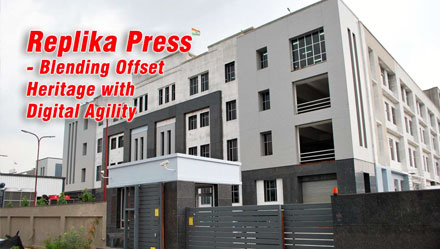
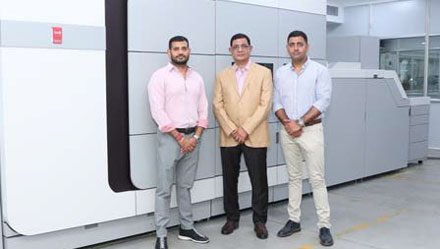
In the ever-changing landscape of global publishing, where speed, flexibility, and efficiency are reshaping print production, Replika Press Pvt. Ltd. stands as a compelling example of how tradition and technology can work hand in hand. A 100% export-oriented unit with deep roots in offset printing, Replika has evolved into a hybrid printing powerhouse by strategically embracing digital printing technology. Three generations in the trade, the company is run by Bhuvnesh Seth, Managing Director and his sons Sanandan Seth - Director Marketing and Vikaran Seth - Director Operations
With customers spread across the
UK, the US, and other international
markets, Replika’s strength lies in
delivering high-quality books at scale,
while now being equally capable of
handling short runs, on-demand titles,
and specialized requirements with
agility. The company’s partnership with
Canon for digital presses marks a new
phase in its growth journey, reinforcing
its position as a trusted print partner for
publishers worldwide.
For decades, Replika has been
synonymous with precision offset
printing and large-scale book
production. But as publishing trends
shifted, the leadership recognized the
need to evolve.
“Globally, academic and medical
print runs are shrinking,” says
Bhuvnesh Seth, Managing Director of
Replika Press. “To provide our
customers with one-roof services, we
invested in digital. Many publishers
today prefer to print fewer copies
initially to avoid unsold stock, and
some have moved to a zero-inventory
model, they don’t maintain warehouses
and print only against orders. Digital
technology makes that possible.”
This change in the publishing
ecosystem presented both a challenge
and an opportunity. For Replika, it
meant expanding capabilities beyond
high-volume offset to include short-run
and print-on-demand (POD) printing.
The result is a seamless hybrid
operation, one that can handle both
massive print runs and single-copy
reprints with equal finesse.
Offset printing remains the
foundation of Replika’s operations,
delivering unmatched quality and costefficiency
for large runs. But digital
printing has introduced a new
dimension of flexibility.
“On digital, we receive a good
number of orders from overseas
publishers to supply books in the
domestic market and to increase
exports,” says Bhuvnesh. “It also gives
us the opportunity to stay in constant
touch with customers. When offset
opportunities arise, they continue to
place their trust in us because we’ve
supported their digital needs.”
The ability to produce both offset and
digital jobs under one roof has helped
Replika retain global customers who
increasingly seek a single, reliable partner capable of handling diverse
production needs.
Replika’s decision to go exclusively
with Canon as its digital press partner
was guided by quality, reliability, and
alignment of vision.
“Canon’s print quality is comparable
to offset,” Bhuvnesh explains. “It
delivers consistency in ink and colour,
and their service support is excellent.
They have developed a team of
professionals who understand our
requirements, and that has helped us
achieve strong growth in both
monochrome and four-colour digital
production.”
For a company that thrives on
precision and perfection, Canon’s
technology has become a natural
extension of Replika’s quality
philosophy. Whether printing short-run
textbooks, specialized academic titles,
or trade books, the Canon presses
deliver consistent output that meets
international standards.
Integrating digital printing required
operational realignment and technical
preparation. “You need to have a
robust IT mechanism to integrate your
system with machines,” says
Bhuvnesh. “That was one of the most
important changes we had to make.”
The shift also demanded a change in
mindset. Offset production thrives on
scale and planning, whereas digital
success depends on speed and
adaptability. Replika retrained teams,
optimized workflows, and introduced
greater automation to handle smaller,
more frequent orders efficiently.
According to Bhuvnesh, the results
are evident. “Turnaround times have
really improved. We are now delivering
books in a day itself, as per customer
requirements. This responsiveness has
become a key differentiator in the
competitive export market, where
publishers value not only print quality
but also the ability to meet tight
deadlines without compromise.”
Digital printing has also opened up
entirely new possibilities for customer
engagement and product innovation.
Publishers today use digital runs for a
variety of purposes, from test
marketing to limited-edition releases.
“Instead of going for wet proofs on
offset, customers now ask for a digital
copy to check the overall appearance
of the book on actual paper before
going into large-scale production,”
Adds Bhuvnesh. “It’s faster, costeffective,
and builds confidence in the
final output.”
Short-run and print-on-demand
production have become an integral
part of Replika’s business. “Print-ondemand
now has more volume than
short runs. It’s a model that aligns
perfectly with the publishing world’s
shift toward efficiency and zero
inventory.”
While Replika’s digital infrastructure
primarily supports overseas clients, its
domestic presence is also growing.
“We are getting strong traction in the
Indian market, especially in academic,
medical, and trade segments,” says
Bhuvnesh.
As digital printing continues to
evolve, Replika is keeping a close
watch on emerging technologies that
could shape the next decade. “Mono
digital printing volumes will increase as
the cost of machines and click charges
decrease compared to colour printing,”
he predicts.
The company is also focused on
adopting automation and artificial
intelligence to further streamline
workflows. “AI is being used in every
field, and printing is no exception,”
says the MD. “We are integrating AIdriven
processes wherever possible to
automate production and achieve the
best efficiency.”
For Replika, this forward-thinking
approach isn’t just about staying
relevant; it’s about leading by example
in an increasingly digital future.
Despite the rapid transformation,
Replika remains firmly anchored to its
founding principles, quality,
commitment, and customer
satisfaction. “Replika Press prints
quality books with commitment under
one roof for both offset and digital. We
have invested heavily in infrastructure
and machinery, using cutting-edge
technology to deliver the highest
standards at competitive pricing.”
This dual capability, traditional
craftsmanship combined with modern
digital agility, has positioned Replika as
a trusted long-term partner for
publishers across continents.
As Replika continues its hybrid
journey, its vision is clear. “Replika is a
renowned name in quality printing
among overseas publishers in the UK
and the US,” concludes Bhuvnesh.
“We aim to keep strengthening that
reputation while embracing new
technologies that help us serve our
customers better.”
Replika Press’s story is one of
transformation, from a traditional offset
powerhouse to a hybrid printing leader
that blends legacy with innovation. By
adopting digital printing and aligning
with Canon as a trusted partner, the
company has strengthened its global
relevance and sharpened its
responsiveness to customer needs. In
a publishing landscape where agility,
sustainability, and precision are
paramount, Replika demonstrates that
progress comes from anticipating
change and acting decisively. As it
looks ahead, Replika Press is not just
adapting to the future of book printing,
it is helping to define it.
In doing so, it exemplifies how an
Indian print exporter can not only adapt
to global publishing trends but also
help define them. |