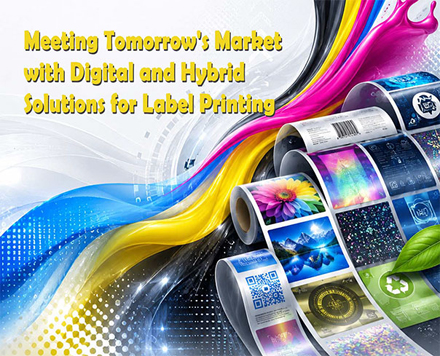
The global label printing industry is undergoing one of the most exciting phases in its
history. Driven by changing consumer behaviour, shorter product life cycles,
sustainability initiatives and rapid technological advancements, the sector is
redefining how labels are produced and used. For decades, flexographic printing
dominated label production, while digital printing was viewed as a niche technology
suitable only for prototypes and short runs. Today, that perception has changed
dramatically.
Digital printing has evolved into a mature production technology capable of handling
a wide range of commercial applications, while conventional printing continues to
remain the preferred choice for high-volume production. Increasingly, converters are
discovering that the future is not about choosing one technology over the other but
about integrating them to create more agile, efficient and profitable production
environments.
“Hybrid or Digital?” How can converters leverage both technologies to meet the
evolving demands of brand owners?
The label has evolved from being a simple identification tool into an integral part of brand
communication. Consumers today expect attractive packaging, personalised experiences,
instant product information and assurances regarding authenticity and sustainability.
Consequently, brand owners are launching more products than ever before, often in multiple
sizes, regional variants and limited editions.
The explosion in Stock Keeping Units (SKUs) has fundamentally altered production
requirements. Instead of ordering millions of identical labels, brands now require multiple
versions with shorter production cycles and faster deliveries. Seasonal promotions,
multilingual packaging, personalised marketing campaigns and regulatory compliance have
become standard expectations rather than exceptions.
E-commerce has accelerated this trend even further. Online brands frequently introduce
limited-edition products and promotional campaigns that require labels in relatively small
quantities but with exceptionally quick turnaround times. This shift has made production
flexibility one of the most valuable assets for label converters.
Traditional flexographic printing continues to offer unmatched productivity for long production
runs. However, every new job requires plate making, press setup, colour matching and
registration adjustments, all of which consume time and generate material waste. Digital
printing, on the other hand, eliminates these preparatory stages, enabling converters to
move directly from artwork approval to production. For short and medium runs, the savings
in setup time often outweigh the higher cost of digital inks, making digital printing an
For Replika, this forward-thinking
approach isn’t just about staying
relevant; it’s about leading by example
in an increasingly digital future.
Despite the rapid transformation,
Replika remains firmly anchored to its
founding principles, quality,
commitment, and customer
satisfaction. “Replika Press prints
quality books with commitment under
one roof for both offset and digital. We
have invested heavily in infrastructure
and machinery, using cutting-edge
technology to deliver the highest
standards at competitive pricing.”
This dual capability, traditional
craftsmanship combined with modern
digital agility, has positioned Replika as
a trusted long-term partner for
publishers across continents.
As Replika continues its hybrid
journey, its vision is clear. “Replika is a
renowned name in quality printing
among overseas publishers in the UK
and the US,” concludes Bhuvnesh.
“We aim to keep strengthening that
reputation while embracing new
technologies that help us serve our
customers better.”
Replika Press’s story is one of
transformation, from a traditional offset
powerhouse to a hybrid printing leader
that blends legacy with innovation. By
adopting digital printing and aligning
with Canon as a trusted partner, the
company has strengthened its global
relevance and sharpened its
responsiveness to customer needs. In
a publishing landscape where agility,
sustainability, and precision are
paramount, Replika demonstrates that
progress comes from anticipating
change and acting decisively. As it
looks ahead, Replika Press is not just
adapting to the future of book printing,
it is helping to define it.
In doing so, it exemplifies how an
Indian print exporter can not only adapt
to global publishing trends but also
help define them. |