



|
|
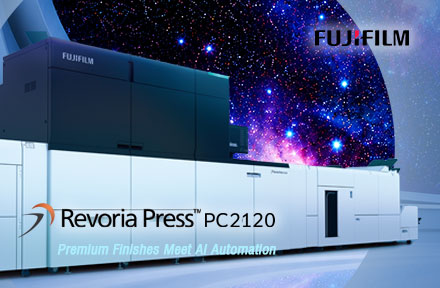 |
Fujifilm’s newest flagship digital press, the Revoria Press PC2120, arrived in 2026 as the
successor to the well-regarded PC1120, and it’s clear the company built it to answer one
question: how do you make digital toner printing feel more like a genuine creative tool? After
digging into its engine architecture, color technology, and automation stack, the PC2120 looks
less like an incremental refresh and more like a genuine step change for print shops chasing
premium, differentiated output.
Technology:
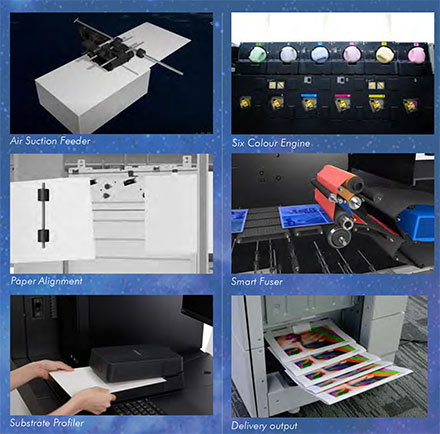
The headline technical feature of the PC2120 is its color engine. Where most production
color presses top out at four toner stations (CMYK), the PC2120 runs a six-color engine with
dual specialty stations that can lay down metallics, , whites, or clear effects in a single pass
alongside CMYK. That “single pass” detail matters more than it might sound, it means a print
shop no longer needs multiple passes through the press (or a separate specialty unit
entirely) to combine, say, a white underprint with a glossy clear coat on a dark substrate.
The job goes through once, which shortens turnaround and reduces the registration
headaches that come with multi-pass work.
Alongside the specialty stations, Fujifilm has introduced a newly developed Green toner that
works in tandem with the existing Pink toner the Revoria line introduced previously.
Together, this expanded palette pushes the press’s color gamut to reportedly cover 93% of
the Pantone Formula Guide Solid Coated library, a meaningful figure for any brand-sensitive
print buyer, since Pantone matching has historically been one of the more frustrating
limitations of toner-based digital presses compared to offset. The system also automates
magenta-to-pink layer separation, streamlining a workflow step that used to require manual
color management expertise.
Underpinning all of this is Fujifilm’s Super EA-Eco toner, which the company praises as
having one of the smallest toner particle sizes in the industry. Smaller particles translate
directly into finer print quality: smoother gradients, cleaner midtones, and cisper reproduction
of small type and thin vector lines, details that matter enormously in packaging mockups,
fine art reproduction, and text-heavy commercial documents alike. Combined with 2400 dpi
native resolution and print speeds up to 120 pages per minute, the PC2120 is positioned to
compete on both quality and throughput rather than forcing a shop to choose one over the
other.
What stood out most in Fujifilm’s own positioning of the PC2120 and in trade coverage is,
how heavily the press leans on AI-driven automation as a selling point, not just a feature line.
Fujifilm frames the launch around “smart press optimization” driven by agentic AI, and the
details back up the framing.
The Substrate Profiler is probably the most immediately useful piece of this stack for day-today
production. Instead of manually testing and tuning settings for every new paper stock, a
process that historically could eat 15-20 minutes or more per substrate, the operator scans the paper and the system automatically determines optimal parameters, significantly
reducing typical paper setup. For shops that run frequent short-run jobs on varied stocks (a
very common reality in commercial print), that time recovery adds up fast across a week.
Layered on top is AI Print Recommendation, which analyzes the characteristics of an
incoming job and suggests image-quality settings tailored to that specific file, vector-heavy
work, photographic content, and fine text all call for different rendering priorities, and the
system aims to make that judgment call automatically rather than relying on an experienced
operator’s instinct. Fujifilm also highlights a one-click press setting at the digital front end that
reportedly speeds up job-specific image quality adjustment by a significant margin compared
to manual configuration, along with real-time detection and correction capabilities that can
assess and adjust text lines, vector graphics, and gradients on the fly, reducing the number
of times a file has to be bounced back to a designer for rework.
Rounding out the automation suite is a Smart Monitoring Gate for ongoing image-quality
stability and an optional Print Inspection System for catching defects during a run. Together,
these tools are explicitly aimed at de-skilling operation: a press that performs consistently
well regardless of who’s running it, rather than one whose output quality is gated by the most
experienced person on shift. That’s a genuinely important shift for an industry facing a
persistent shortage of skilled press operators.
On the workflow side, the PC2120 pairs with Fujifilm’s own Revoria Flow print server, which
handles RIP processing at 1200 × 1200 dpi for fast, high-resolution image generation,
though shops that prefer a third-party DFE can opt for a Fiery print server instead, a sensible
bit of flexibility for print operations already standardized on Fiery elsewhere in their fleet.
Media handling gets a practical upgrade too, with an Air Suction Feeder Tray designed to
reliably pull coated stocks that tend to cling together in traditional friction-fed trays.
Combined with a range of available feeding and finishing units, the press is built to move
quickly between substrate types without extended reconfiguration, a real-world necessity for
shops juggling packaging mockups one hour and direct mail the next.
|
Applications:
The technology only matters in terms of what it lets a print shop deliver, and the PC2120’s
feature set points fairly clearly at a handful of high-value application categories:
Packaging and prototyping. The combination of white underprint, metallic and, and clear
effects in a single pass makes the PC2120 well suited to short-run packaging samples,
retail-ready prototypes, and specialty carton work where brands want to preview premium
finishes without committing to an offset run or costly foil stamping. Brand and marketing collateral. With 93% Pantone coverage and automated color
consistency tools, the press is a strong fit for brand-sensitive marketing materials, think retail
point-of-sale displays, premium brochures and direct mail, where getting a logo’s exact color
wrong is a non-starter.
Photographic and fine-art reproduction. The small toner particle size and smooth gradation
handling should benefit photo books, art reproductions, and portfolio pieces where banding
or harsh tonal transitions would be immediately visible.
Invitations, greeting cards, and luxury print. Metallic and specialty effects applied inline
(rather than as a secondary finishing step) make short-run luxury stationery, wedding
invitations, and premium greeting cards a natural application, jobs where a subtle metallic
sheen or spot-gloss effect adds perceived value without the cost overhead of foil stamping
equipment.
Short-run commercial and transactional print. The speed (120 ppm), reduced setup time via
the Substrate Profiler, and reduced dependence on specialized operator skill make the
PC2120 a candidate for shops that need to keep a diverse, fast-turnaround job mix moving
without dedicating a specialist to babysit every substrate change.
The Revoria Press PC2120 reads as a print shop’s answer to two persistent problems: a
ceiling on differentiated, premium finishes achievable digitally, and a growing skills gap on
the pressroom floor. By folding metallic, , white, and clear-effect capability into a single-pass
six-color engine, and pairing that with genuinely substantial AI-driven setup automation,
Fujifilm has built a press aimed squarely at shops trying to win higher-margin specialty work,
packaging, brand collateral, luxury stationery, without needing to staff up with colormanagement
veterans to run it consistently.
For that audience, though, the PC2120’s blend of expanded color capability and intelligent
automation looks like a genuinely compelling upgrade path rather than a marketing exercise.
|
| Back to News |
|
|

|
|




