



|
|
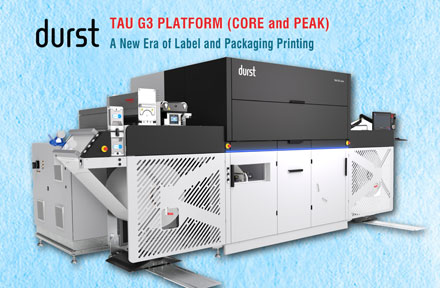 |
Labelexpo Europe 2025 set the stage for one of the most significant
launches in digital printing this year: the Durst Tau G3 platform. With two
models, Tau G3 Core and Tau G3 Peak, the new generation builds on
Durst’s strong Tau RSC legacy and positions itself as a future-ready
solution for converters dealing with fast-changing brand demands.
For Indian converters, the relevance of this launch cannot be
overstated. India’s FMCG, food, beverages, and pharmaceutical
industries are all shifting toward shorter runs, more SKUs, and faster
turnaround times. The Tau G3’s blend of 1200 dpi quality, flexible ink
options, broader substrate compatibility, and operator-friendly
ergonomics makes it a compelling candidate for converters here who
want to strengthen their digital print capabilities.
The Technology:
Durst has gone all out to close the
quality gap between conventional and
digital. At the heart of the G3 platform
is a native 1200 × 1200 dpi print
resolution with variable drop sizes
between 2–6 picolitres. This sharpness
ensures the clean reproduction of small
text, intricate graphics, and security
elements, features that India’s pharma
and healthcare sectors demand. For
converters printing medicine labels with
tiny barcodes or multilingual dosage
instructions, this resolution is more
than just a specification; it’s a
competitive advantage.
The platform comes in two speed
configurations. The Tau G3 Core, a
balanced solution running at 61 metres
per minute, while the Tau G3 Peak runs
at 80 m/min, with configurable options
that push the Peak toward 100 m/min
depending on the chosen
configuration. Durst positions the Core
as a balanced production solution and
the Peak as the high-productivity
option for converters with a heavier
digital workload. Those speeds,
combined with the higher native
resolution, are what make the G3
platform attractive for label printers
seeking both quality and volume.
Both versions use Samba G3L
Dimatix printhead technology, known
for its grayscale modulation and
consistency over long runs. The
combination of head technology and
ink control is central to the machine’s
claim of delivering “razor-sharp” and
consistent results across substrates.
Indian brands are pushing converters
to deliver brighter colours, wider
gamuts, and embellishment-like effects
without adding costs. The Tau G3
addresses this with a CMYK base set
and extended gamut inks including
Orange, Violet, and Green, plus highopacity
White. For converters catering
to premium cosmetics, liquor, and
personal care brands, this range
means better spot-matching and
metallic effects when white ink is used
on transparent or metallised films.
The Tau G3 supports papers,
synthetic films (PET, PP, BOPP),
metallized foils and linered
constructions with thicknesses
spanning roughly 20–500 μm, a useful
envelope for label and flexible
packaging runs. Durst highlights both
coated and uncoated substrates as
supported, which is relevant for
converters who run mixed jobs (from
commodity pressure-sensitive labels to
premium shrink sleeves and flexible
pouches). The ability to handle white
ink effectively on transparent and
metallized films, together with higher
dpi, is an important selling point for
premium decorative work.
The choice of UV or LED curing
ensures that Indian converters can
tailor the machine to food-grade
requirements or energy-saving
initiatives, depending on their customer
base. LED curing, in particular, will
resonate with converters looking to
lower energy bills and improve
sustainability scores, an area where
Indian brands are becoming more
vigilant.
Beyond raw print specs, Durst says
the Tau G3 is designed around
“Reliability, Simplicity, Performance.”
That is reflected in mechanical and
user-experience updates: improved
ergonomics; an intuitive, modern UI; a
prominent LED status strip that gives
remote visual feedback; and easier
access to service points such as the
electrical cabinet and cooling system.
These are small but meaningful
refinements that reduce operator
fatigue, cut mean time to repair and
speed routine maintenance, especially
important at higher running speeds and
in 24/7 production environments.
Durst has also emphasized
integration with its overall software
ecosystem, promising tighter links
between the press and prepress/DFE,
job management and colour control
systems. For label shops, such
integration limits manual interventions,
enables better job traceability, and
supports automation of repeat or
variable data jobs, again, a commercial
advantage for converters chasing
shorter lead-times. Trade coverage
from the show noted new automation
functions on the G3 that push it toward
highly automated digital production

|
Applications:
The combination of higher dpi,
extended gamut ink sets, white ink
capability and substrate breadth
means the Tau G3 is well-suited to a
range of label and flexible packaging
segments.
With thousands of SKUs, Indian
FMCG brands constantly refresh
packaging for promotions, regional
flavours, and seasonal campaigns. The
Tau G3 Peak’s higher speeds allow
converters to take on these jobs with
faster turnarounds while maintaining
vibrant, high-resolution output.
Premiumisation is driving demand for
high-quality decorative labels with
metallic and transparent substrates. The Tau G3’s opaque white ink opens
up creative options for spirits, wine,
and craft beer producers in India’s
metro markets.
India is the world’s largest supplier of
generics in the Pharmaceuticals and
Healthcare segment, exporting to over
200 countries. The G3’s 1200 dpi
sharpness ensures scannable
barcodes and microtext, critical for
compliance with GS1 standards and
emerging traceability regulations.
Security features such as guilloche
patterns or invisible marks can be
reliably rendered with the new
printhead technology.
More Indian converters are
diversifying into short-run pouches and
sachets for nutraceuticals, spices, and
snacks in Flexible Packaging. The G3’s
film-handling capability and extended
gamut colours allow converters to
produce packaging prototypes and
market-test batches quickly, a segment
that’s growing rapidly with the boom in
D2C (direct-to-consumer) brands.
Importantly, converters that mix
conventional and digital jobs will value
the Tau G3’s image quality and speed
as a way to bring more SKUs in-house
without sacrificing aesthetic
expectations. That’s especially true in
markets where brands want litho-like
finishes on short runs or need multiple
SKU variants produced cost-effectively.
Durst highlights a practical redesign
across the platform: improved
component accessibility, an enhanced
cooling layout and easier access to
consumables and service points.
These engineering choices matter
operationally, faster changeovers,
simpler head access and clearer status
signage keep uptime high and reduce
the operator learning curve. For
production managers, those factors
translate to predictable throughput and
lower unplanned downtime.
On sustainability, Durst’s public
messaging around the G3 echoes
broader industry trends: reduced waste
through digital on-demand production,
ink chemistries designed for food-safe
or low-odour applications where
applicable, and LED curing options
that can lower energy consumption in
some configurations. While the
company stops short of announcing
radical new sustainability claims at
launch, the platform’s ability to replace
make-ready waste from traditional
analog jobs is an implicit environmental
benefit frequently cited in trade
reporting from Labelexpo.
Durst has positioned the G3 as the
natural evolution of its Tau family and
the Tau RSC architecture, with an
emphasis on “out-of-the-box”
productivity and enhanced operator
friendliness. Durst’s G3 appears aimed
at converters who want a future-proof
platform: high native resolution, flexible
inks and strong ergonomics for
scaleable growth. The two-model
approach (Core and Peak) lets buyers
choose between balanced costperformance
and top-end throughput.
Trade commentators at Labelexpo
noted that Durst is trying to close the
gap between conventional print quality
and the immediacy of digital, a
sensible play as brands move more
SKUs to digital and expect higher
aesthetics.
The launch of the Durst Tau G3 at
Labelexpo Europe 2025 is more than a
global headline. It signals a practical,
timely opportunity for Indian converters.
With its balance of quality, speed,
flexibility, and operator-centric design,
the G3 is set to become a strong
contender in the Indian digital label and
packaging space.
For India’s FMCG giants, pharma
exporters, and fast-growing regional
brands, the message is clear: the label
and packaging press of the future is
here, and it’s engineered to meet the
demands of one of the most dynamic
consumer markets in the world.
The Tau G3 will be introduced into
India through Newgen Printronics India
Pvt. Ltd., Durst’s established channel
partners for standalone and hybrid
digital printing solutions for labels and
flexible packaging. |
| Back to News |
|
|

|
|




