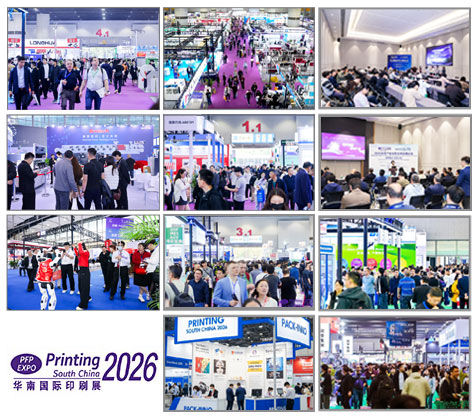
The three-day 32nd Printing South China/Sino-Label closed successfully after what organisers and participants broadly described as one of the most commercially productive editions in the event’s history. Characterised by strong exhibitor diversity, deep international buyer engagement, and a concentrated focus on implementable rather than merely aspirational technology, the show delivered on its promise to reflect the printing and packaging sector’s real direction of travel.
Held alongside the China International Exhibition on Packaging Machinery & Materials (Sino-Pack) and the China (Guangzhou) International Exhibition on Packaging Products & Materials (PACK-INNO), the combined event spanned 150,000 square metres and featured 2,218 exhibitors across a single interconnected venue. Total professional visitor attendance reached 129,037, a figure that included approximately 14% overseas visitors, underscoring both the global appetite for Chinese printing and packaging technology and the sector’s continued resilience.
Overseas buyer delegations arrived from 126 countries and regions, spanning Russia, Malaysia, Thailand, South Korea, Vietnam, the Philippines, Uzbekistan, Indonesia, Kazakhstan, Turkey, Spain, Australia, Brazil, Germany, India, Japan, the United States, Hong Kong (China), and Taiwan (China). The breadth and depth of this international participation gave the show floor an atmosphere that exhibitors described as unprecedentedly global.
The exhibition’s press briefing was addressed by representatives from the organising bodies.
Hua Qiansheng, Vice General Manager of the Huaxing Branch of China Foreign Trade Guangzhou Exhibition, noted that 2026 marks the opening year of China’s 15th Five-Year Plan period. This edition of the show has been deliberately aligned with national strategy, anchored by the theme of “Digital, Intelligent, Sustainable” and structured around four guiding dimensions: New, Intelligent, Green, and Integrated. The goal, he said, is to create a 150,000-square-metre platform showcasing the full industry chain, generating momentum to drive industrial development.
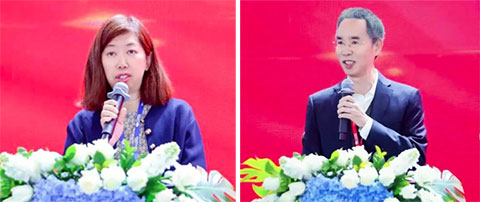
Celine To, General Manager of Adsale Exhibition Services Ltd, reinforced the event’s significance in her opening remarks. As the printing and packaging sector’s first major gathering after the Lunar New Year, Printing South China/Sino-Label functions, she said, as an essential barometer for industry trends, annual planning, and collective growth. With the sector navigating profound structural shifts, this year’s edition has been deliberately reoriented around actionable, implementable solutions rather than aspirational concepts, injecting tangible momentum for enterprises seeking to upgrade and transform.
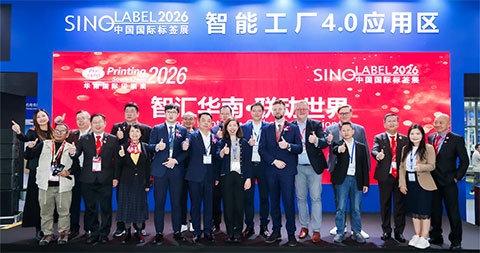
The official launch of the Smart Factory 4.0 demonstration was the signal for the event to begin in earnest. Guests and media present collectively marked the moment, with a burst of applause and camera shutters punctuating the atmosphere.
If there was a single zone that defined the mood of the show floor, it was the Smart Factory 4.0 Application Area, a functioning micro-workshop that drew sustained, substantial crowds from the moment doors opened. Meiqi, a well-regarded label manufacturer whose client roster includes P&G, Liby, and Unilever, made its exhibition debut here, joining eleven other leading players across the supply chain to address specific production challenges in the daily chemical, food, and beverage sectors, notably around fast turnaround times and personalisation at scale.
The result was two fully linked digital production lines demonstrating both small-batch flexible manufacturing and large-scale mass production. From AI-driven scheduling and digital printing through post-press finishing to AI-assisted visual inspection, every stage featured live data visualisation. Visitors were able to place orders on the spot and watch personalised labels progress from digital file to physical product in real time, a compelling demonstration that left few observers unmoved.
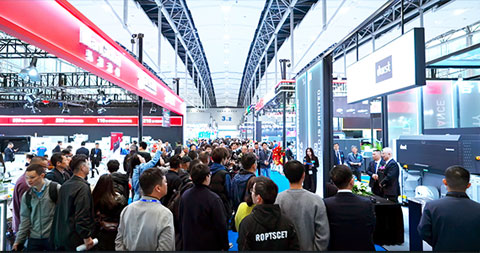
The broader exhibition floor delivered a concentrated showcase of where the industry is heading, with major players making their presence felt across every category.
In digital printing, HP, Konica Minolta, Durst, Weigang and Xeikon each launched core solutions supporting wide substrate ranges, food-safe toner systems, and high-speed Single Pass rotary configurations. Yingkejie, Zhiyi, and Zhilian presented high colour-fidelity printing for book, educational, and commercial applications, collectively expanding the boundaries of production efficiency.
Post-press finishing saw plate-free digital equipment for foiling, 3D embossing, and spot varnishing. In smart manufacturing, software systems integrated the data chain from order intake and scheduling through to production management. Meanwhile, exhibitors in the green materials sector, presented eco-friendly inks and functional label materials optimised for high-speed digital printing.
Throughout the halls, companies presented the latest applications of artificial intelligence in printing, post-press processing, and quality control. Visitors gathered closely to see AI-powered digital inkjet all-in-one machines achieving full automation of printing, inspection, and data management.
Hall 2.1 hosted the Flexible Packaging Innovation Workshop, which connected exhibitors covering the core process sequence of software, flexo printing, laminating, curing, slitting, and bag-making, creating a visible end-to-end food flexible packaging production line. The finished flexible packaging products on display served simultaneously as a demonstration of manufacturing capability and a source of design inspiration.
The Innovative Packaging Materials Zone and Green Label Materials Zone maintained a steady flow of inquirers throughout the opening day.
The Anti-Counterfeiting Traceability Zone brought together various companies in a combined showcase of materials, intelligent equipment, and complete one-stop traceability solutions. Live demonstrations of precision identification technology gave tangible form to the value of brand protection and made a strong impression on attendees.
The RFID Intelligent Zone mapped the full ecosystem from chip design and intelligent lamination through to real-world application, spanning eight sectors including footwear and apparel, retail, and logistics. Conversations between exhibitors and buyers focused on how a single RFID tag can break down data silos and create incremental value in new retail environments, with enthusiasm evident on both sides of those discussions.
The fourth Printing Technology and Creativity Awards zone attracted considerable foot traffic. This year’s competition centred on a real-world brief from the historic Guangzhou Restaurant Group, which set the mooncake packaging challenge for entrants. Winning and shortlisted works were on public display, with representatives from Guangzhou Restaurant Group present on the show floor for direct conversations with the creative companies behind them. Reports from the opening day indicate that some award-winning studios have already secured preferred-supplier status, a model in which the competition arena becomes a genuine commercial marketplace, offering especially valuable pathways for smaller studios and independent designers.
Trend-led and culturally creative packaging provided an adjacent focal point, with iridescent film, tactile inks, and augmented reality interactive packaging all represented. Representatives from several trend-focused consumer brands were on hand exploring how packaging can meaningfully enhance product value and consumer experience.
Concurrent forums covering innovative technology, digital transformation, intelligent manufacturing, new materials, green packaging, anti-counterfeiting, and creative marketing all ran to capacity throughout the opening day, with lively audience participation.
Serving as a practical resource for Chinese companies planning global operations, the show features multiple outward-facing programme strands. The flagship international forum ‘Opening Up New Blue Oceans in Printing & Packaging’ extended its reach to five emerging markets: Kazakhstan, Brazil, Egypt, Poland, and Malaysia. Local industry specialists will addressed topics including demand in the Kazakhstani and American markets, prospects across the Middle East and Africa, and practical experience of central European printing and packaging development.
Beyond the headline attractions, the 2026 edition featured dedicated zones for Digitalisation and Application, Creative Packaging Materials, Paper Container Packaging, Flexible Packaging, Corrugated Packaging, Digital Label Printing, Eco-Flexographic Printing, Green Label Materials, RFID Smart Labels, and Anti-Counterfeiting Traceability & Solutions — each offering its own depth of content for specialist visitors.
The shared sentiment at the close of the 2026 show was captured in a single phrase repeated throughout the halls: “See you next year.” Building on the 2026 edition’s achievements, the 33rd South China International Exhibition on Printing Industry and the China International Exhibition on Label Printing Technology will return to Area A of the China Import and Export Fair Complex, Guangzhou.
|