Three days in Goregaon told a story about an industry that has stopped asking whether digital is the future and started asking how fast it can get there.
There is a particular energy that settles over the Bombay Exhibition Centre in April. It is not quite the controlled chaos of a consumer fair, nor the hushed gravity of a corporate conference. It sits somewhere in between, part bazaar, part boardroom, with the background hum of machinery that actually works for a living. That energy was on full display from 9 to 11 April, when Media Expo Mumbai returned for its 57th edition, drawing professionals from across the signage, branding, outdoor advertising, and print sectors into one sprawling, purposeful gathering.
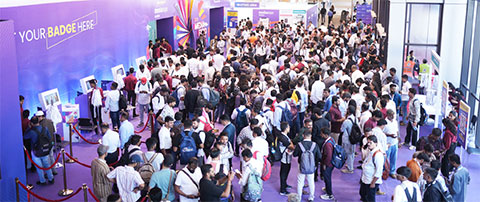
The numbers told part of the story. Around 150 exhibiting companies, more than 250 brands, and upwards of 12,500 visitors across three days, figures that, on their own, describe a healthy trade event. But what made this edition feel significant was less about scale and more about direction. The industry that showed up to Goregaon this April was one that has clearly made its peace with change and is now in the business of managing it.
Walk any trade fair long enough and you develop a sense for what is genuinely new versus what has been dressed up to look that way. At Media Expo Mumbai 2026, the technologies generating the most serious conversations were not speculative. They were on, running, producing output, and being scrutinised by buyers who had budgets and decisions to make.
Large-format UV printing systems were demonstrating versatility across substrates that would have seemed exotic a few years ago. Eco-solvent and hybrid machines were drawing clusters of MSME operators who have clearly moved past the question of whether to invest in new equipment and are now comparing specifications. LED-based display systems, walls, thin-frame backlit panels, programmable digital screens, occupied a significant portion of the floor and attracted sustained attention from visitors representing retail chains, infrastructure projects, and event companies.
What stood out across many of these conversations was a recurring theme: the replacement of static vinyl with dynamic digital. Programmable displays that can be updated remotely, repurposed across campaigns, and eventually retired without generating landfill are no longer a premium novelty. They are becoming a practical proposition for environments as varied as metro stations, shopping malls, airport terminals, and point-of-sale retail and exhibitors in this space were visibly confident about where demand is heading.
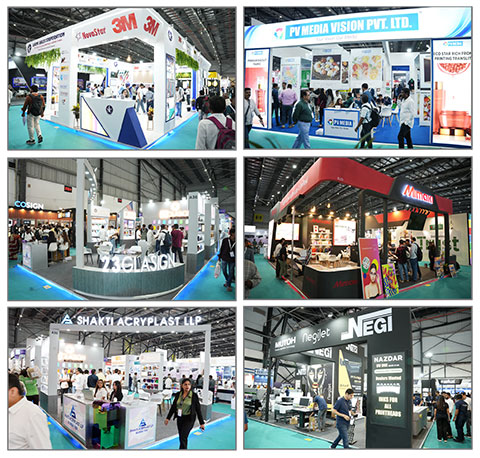
India’s infrastructure expansion is doing a great deal of the work here. The country’s ongoing investment in metro networks, smart city development, highway corridors, and upgraded airports has created a pipeline of projects that require sophisticated signage and wayfinding systems at scale. For the businesses gathered at this show, that pipeline represents genuine opportunity and many of them came to Mumbai specifically to position themselves to capture it.
The big brand names attract the press releases, but the real texture of Media Expo Mumbai has always been its MSME population, the proprietors, fabricators, and print shop owners who drive a disproportionate share of actual industry output in India. This year’s edition reflected their growing ambition clearly.
Conversations on the floor revealed businesses diversifying aggressively: from standard flat signage into dimensional lettering, illuminated acrylic, all-weather installations, and LED channel work. The materials being explored have expanded well beyond traditional flex and vinyl into metal-effect finishes, fluorescent acrylics, and specialised architectural substrates. Several exhibitors noted that their MSME customers are now asking questions about material science and longevity that would previously have been the preserve of much larger operators.
This is an industry in the middle of a genuine skills upgrade, driven partly by market demand and partly by the availability of better, more accessible equipment. The two reinforce each other, and Media Expo, as a place where equipment makers and end-users meet directly, is one of the mechanisms through which that cycle accelerates.
The decision to open the 57th edition with an all-women inauguration panel was not simply symbolic, though it carried genuine symbolic weight. The PowHER in Print initiative, developed in collaboration with the global Girls Who Print network, used Day 1’s knowledge sessions to push into territory that trade events in this sector have historically avoided: structural questions
about who leads, who is trained, and who is visible in a predominantly male industry.
The sessions tackled women’s leadership trajectories in print and signage, the specific disruptions that AI and automation are creating for brand-facing roles, and the urgency of upskilling in a moment when technology is redefining job descriptions faster than most training programmes can respond. Attendance was strong, and the quality of the conversation suggested this was not a checkbox exercise. Whether the momentum generated in that room translates into sustained structural change in the industry is a longer-term question but the fact that the question is now being asked loudly at a major trade platform is itself meaningful.
On this occasion, Raj Manek, Executive Director & Board Member, Messe Frankfurt Asia Holdings Ltd, expressed: ”It is encouraging to witness the strong industry response at the 57th edition of Media Expo Mumbai. The show continues to evolve alongside the rapidly transforming landscape of signage, branding and digital communication, bringing together technology providers, creative professionals and business leaders on one platform. It is also heartening to see the scale and variety of advertising, branding and signage solutions gaining wider adoption across sectors such as retail, infrastructure and advertising as these industries continue to expand.”
The second day shifted register, moving from the inspirational to the operational. The standout session was built around System52, a 52-week structured execution framework designed for print and packaging factories, which addressed something many MSME owners quietly struggle with: the gap between having good equipment and running a genuinely efficient business. Sessions like this, grounded in practical workflow management rather than aspirational vision, tend to generate the most genuine engagement at trade events, and the audience response here was no exception.
Day 3 gave the show a chance to breathe, a final day where deals were consolidated, contacts were exchanged, and the floor took on the slightly looser atmosphere that follows two days of intense commercial activity. It is often on days like this that the most candid conversations happen, away from formal presentations and sales pitches. By all accounts, there was no shortage of them.
Media Expo Mumbai 2026 was not a show defined by a single breakthrough product or a dramatic announcement. Its significance was more cumulative, an accumulation of evidence that a sector once characterised by manual craft and analogue methods has undergone a genuine technological shift and is now navigating the more complex questions that follow such shifts: sustainability, workforce development, market consolidation, and the role of digital intelligence in creative and commercial decision-making.
The show’s broadening support base, drawing in printers’ associations from Delhi, Lucknow, and beyond, reflects an industry that is thinking nationally even when it operates locally. And the next stops on the Media Expo calendar, Chennai in July and New Delhi in September, suggest an organiser equally committed to that national conversation.
For three days in April, Mumbai was where that conversation was loudest. The industry that filled those halls is moving, not uniformly, not without friction, but with a clarity of direction that would have been harder to read even a few years ago. That, more than any single product launch or attendance figure, was the real takeaway from the 57th edition.
Media Expo is organised by Messe Frankfurt Trade Fairs India Pvt. Ltd. The next edition takes place in Chennai, 9–11 July 2026.
|