Some conferences inform. A rare few transform. Canva Create 2026, held at the iconic
Hollywood Park in Los Angeles, firmly belonged to the latter category. More than 6,000
attendees gathered at Hollywood Park for the third Los Angeles edition of Canva’s flagship
event, where the company quite literally turned its interface into a physical world. What
unfolded across the sprawling campus was less a conventional tech conference and more a
full-day festival, part product showcase, part creative playground, part cultural moment.
The energy was unmistakable from the moment doors opened. They opened with a live
orchestra, setting the tone for an event that would consistently defy expectations. At the
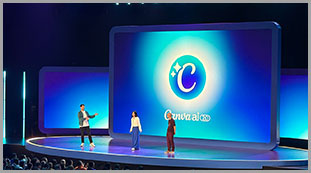
centre of the event was Canva’s keynote presentation, where company leadership unveiled
major product updates alongside storytelling-driven presentations and guest appearances.
Founders Melanie Perkins, Cliff Obrecht, and Cameron Adams took the stage to announce
what many are calling Canva’s most significant product launch in its history, over 70 new
features in a single keynote.
The headline announcement was Canva AI 2.0, a powerful evolution of the platform’s
artificial intelligence tools. Canva AI 2.0 is now scheduling automated content runs,
publishing directly to custom domains, and running agentic workflows without per-output
human approval. Other launches included a new Print Shop, Offline Mode, and LearnGrid,
each designed to widen access and deepen functionality for creators worldwide. The Print
Shop added a sustainability commitment: one print order, one tree planted, through
restoration projects in Malawi, Tanzania, and the Philippines.
The speaker lineup was nothing short of stellar. The programming spanned design, fashion,
film, and business, with appearances from Jon M. Chu, Aurora James, Bobby Hundreds,
and Debbie Millman. Issa Rae and Aurora James spoke on using creative influence to drive
equity and lasting impact, while digital artist Refik Anadol joined Cameron Adams to explore
how AI transforms data into living art environments.
Beyond the stage, the Product Playground stole hearts. The idea was using an entry portal
as a real portal that takes someone inside of the Canva UI, product features became
physical installations, with slides, swings, and AI demo stations turning software into
something you could touch and feel. The debut of Canva Originals, a new lifestyle
merchandise line, rounded out a day that felt as much about culture as code.
For anyone who attended, or streamed in from across the globe, Canva Create 2026 offered
a compelling vision: that creativity, technology, and community, when brought together with
genuine intention, can produce something truly extraordinary. Hollywood Park will not forget
this one easily.
BACK TO NEWS |